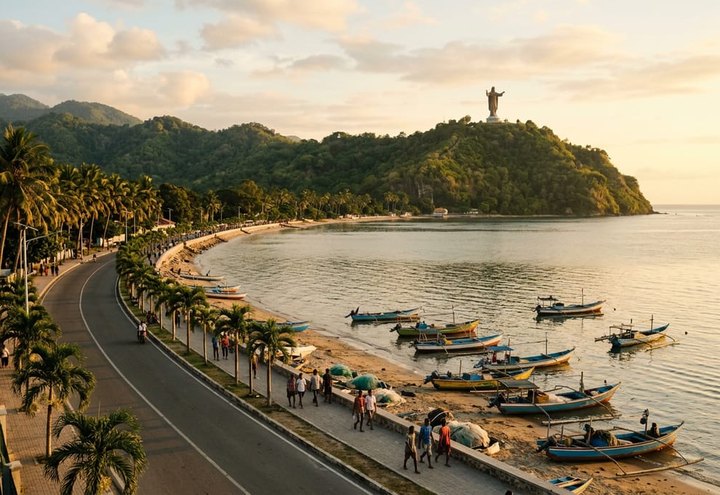
It is a little over 250 kilometres by road from Dili to Tutuala, the village at the country's eastern tip, and the journey takes most of two days. Distance is not the difficulty. The coast road east runs so close to the water that spray reaches the tarmac in places, and it bends around every headland rather than through it.
The first leg, Dili to Baucau, is the easiest: three to four hours in a shared microlet, past salt pans, river mouths and long grey beaches. Baucau, the second city, is built on two levels. An upper town of arcaded Portuguese-era buildings sits around the market; below it a spring feeds a swimming pool cut into the rock. It earns a night rather than a stop.
From Baucau the road turns inland and climbs through teak and eucalyptus to Lospalos, in the heart of Fataluku country. The traditional houses here stand on stilts under steeply pitched thatch, a form found nowhere else in the region. Onward transport thins out considerably. Most travellers arrange a vehicle in Lospalos for the last 40-odd kilometres to Tutuala, where the road ends on a bluff above the sea.
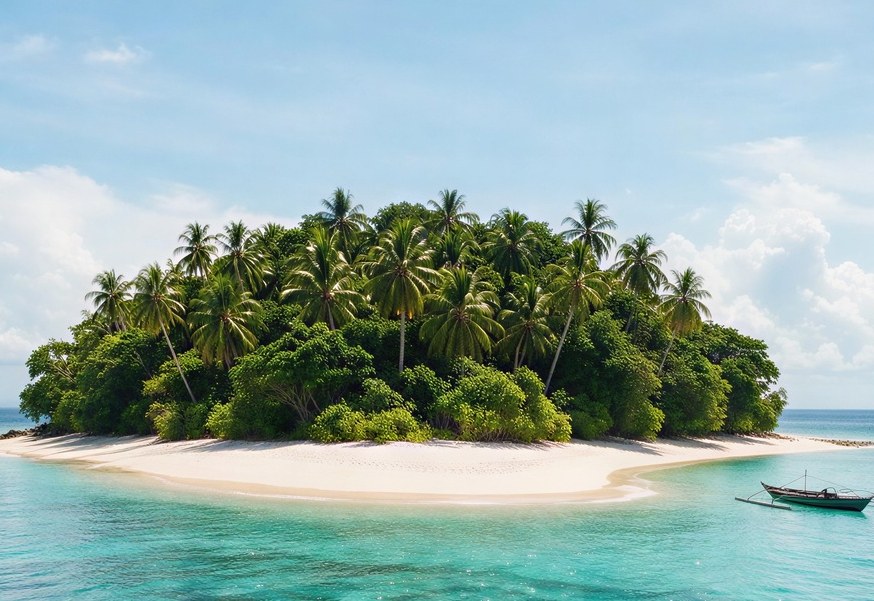
Below the bluff a rough track drops to Valu beach, inside Nino Konis Santana National Park. There is no jetty. Fishermen run small boats across the strait to Jaco Island on demand, and the crossing takes minutes rather than hours, though the current between the two shores is strong enough to be treated seriously.
The rule on Jaco
Jaco is uninhabited and locally held to be sacred. Nobody stays overnight, visitors and boatmen alike. The last passengers are collected in the late afternoon and the island is left to itself. The sand is white, the water clear enough to make depth hard to judge, and beyond the treeline there is no shade, no water and no shelter. Beds are on the mainland side, in simple huts near Valu.
The return is the same road in reverse, which is the argument for spreading the whole thing across four or five days rather than three. Travellers with time break the journey at Com on the north coast, or continue around the eastern cape to the south side, where the surface is rougher and the traffic close to nonexistent.