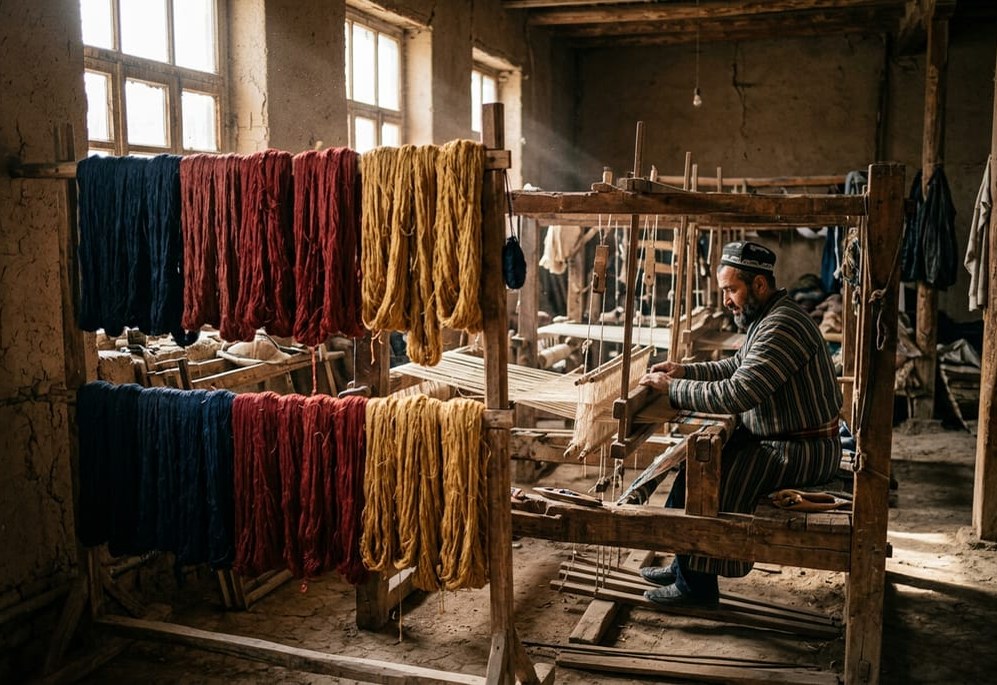
In the workshops of Margilan the pattern goes onto the thread rather than the cloth. Bundles of silk are bound tight in sections, dipped, dried and bound again, colour by colour, before a single length is put on the loom. The weaving then reassembles a design that has never existed as a whole picture until that moment, which is why the edges of Uzbek ikat blur the way they do. The technique has been worked here for centuries and is still taught by apprenticeship.
Margilan sits in the Fergana Valley, the wide agricultural basin at Uzbekistan's eastern end, shared at its edges with Kyrgyzstan and Tajikistan. It is the most densely populated part of the country and the least visited by travellers coming for Samarkand and Bukhara. The valley's monuments are fewer and smaller. Its crafts are the reason to come.
Half an hour south, Rishton has made ceramics from local clay for a very long time. The blue and turquoise glazes derive from ash-based recipes prepared in the town itself, and the potters work in family compounds where the kiln, the wheel and the showroom occupy the same courtyard. Prices are set on the spot and pieces travel badly, which is worth remembering before committing to a large plate.
Kokand and the road in
At the western end of the valley, Kokand was the capital of its own khanate until the Russian conquest of the 1870s. The palace of Khudayar Khan survives in part: a broad tiled facade in ochre, green and blue, and a sequence of surviving rooms now used as a museum. It reads less as a ruin than as a fragment of a much larger complex, which is precisely what it is.
Access from Tashkent has changed considerably. The rail line runs through a long tunnel under the Kamchiq Pass, cutting a slow mountain drive to a few hours by train; shared taxis still take the road over the pass for those who want the view. Within the valley, cities are linked by frequent shared cars, and a day is enough to cover two of the three craft towns.
Spring and autumn are comfortable, with high summer hot and the markets at their best in September. Guesthouse rooms run in the region of US$25 to US$50 (indicative, 2026). The valley suits a slow three days more than a day trip.