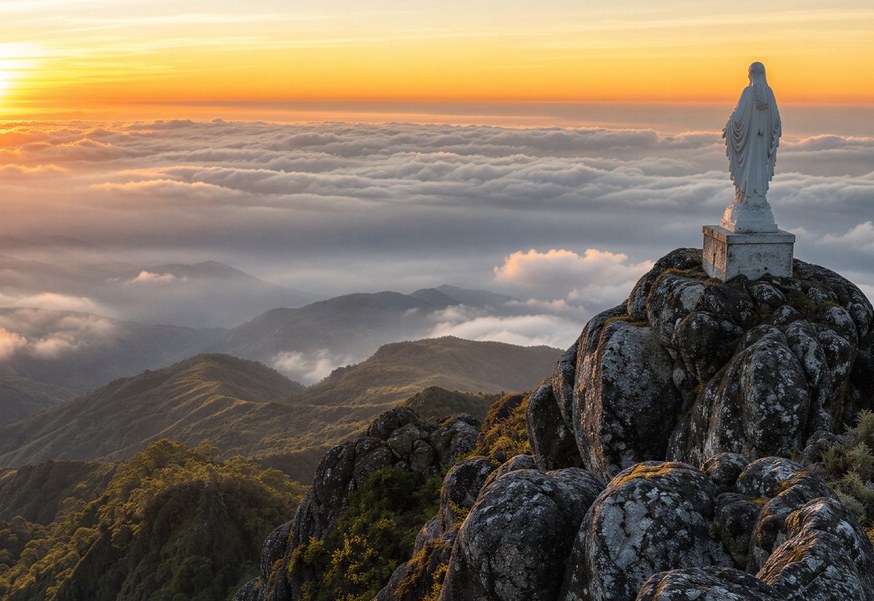
The walk up Tatamailau begins in the dark, usually around three in the morning, from the village of Hato Builico at the end of a long unsealed climb out of the coastal heat. The summit stands at roughly 2,986 m, the highest point in Timor-Leste, and the surprise near the top is the cold rather than the effort. A statue of Our Lady stands at the summit, and in October pilgrims arrive in numbers. On an ordinary morning there may be nobody at all.
We filmed it the way we film everything: the camera does not move. The tripod went down before first light and stayed in one position, framed east, through a sequence of unhurried clips. What changes in the frame is the weather. The cloud floor below the ridge shifts from a flat grey sheet to something with edges and shadow, then goes gold along its top surface, and the ridgelines of the interior begin to show through it as islands. Nothing is cut to music. The lower third reads MOUNT RAMELAU (TATAMAILAU), TIMOR-LESTE, and it stays put.
The film is deliberately short on incident. Wind moves the grass at the frame edge. A figure crosses the ridge and leaves. Ice is not a factor, but frost on the upper slopes is, and it burns off within an hour of the sun clearing the horizon.
Why the camera stays still
A moving camera makes a claim about a place: it tells you where to look and how fast. A fixed frame does the opposite. Held long enough, it hands the viewer the job of finding what is worth watching, which in mountain country is usually the light rather than the landform. It also, more practically, records what a person standing there would actually see, which is the only useful test we know for travel footage.
The climb is a straightforward walk rather than a technical ascent, but it is cold, steep in its last section and undertaken in the dark. Guides can be arranged in Hato Builico, the dry months from June to September are the reliable window, and warm layers matter more than most people expect of a country this close to the equator. Set out early enough to be at the top before the sky changes, not after.