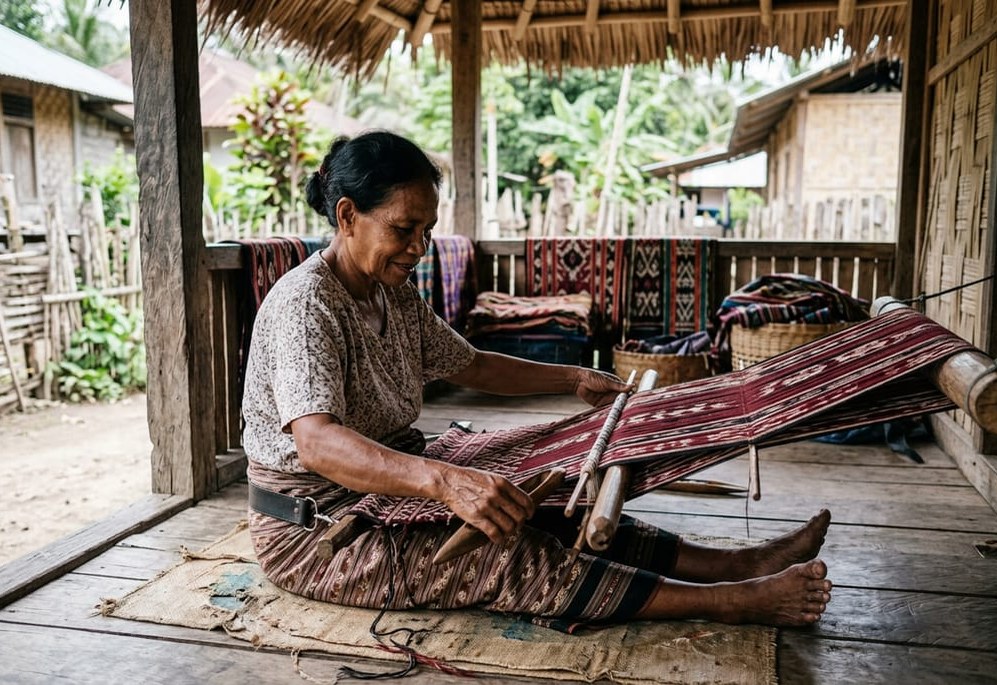
A backstrap loom is a few smoothed sticks, a length of warp and the weaver's own body. She leans back to bring the threads under tension and forward to release it, and the cloth grows a centimetre at a time. There is no frame, no treadle and no mechanism to hurry. A woman working on a full ceremonial tais, between water-carrying and cooking and everything else, may be at the same piece for weeks.
Tais is Timor-Leste's handwoven textile, and it is not decorative in the way souvenir cloth usually is. It is worn and it is given. Tais mane, the men's cloth, is a broad rectangle wrapped at the waist or carried over one shoulder. Tais feto, the women's, is sewn into a tube and worn as a wrapped dress. Both appear at weddings, funerals and the long negotiations of obligation between families, where cloth is counted out and remembered. A guest greeted formally may find a narrow tais placed around the neck; it stays on.
Patterns are regional, and many belong to a particular community rather than to the country at large. Dense geometric banding reads differently from the figurative motifs - crocodiles, human figures, stars - woven elsewhere, and a weaver can usually place a cloth by its stripe sequence and its reds. Older pieces carry natural dyes: indigo for the blue-blacks, morinda root for the deep rust that gives tais its reputation. Commercial cotton and synthetic dye are common now, which is neither scandal nor secret. The labour is still in the loom.
Buying from the weaver
Dili's tais market is the obvious first stop and a fair place to learn the vocabulary, though a share of what hangs there is made quickly for visitors. District markets and women's weaving cooperatives are slower and better. Look at the reverse of the cloth: on a woven piece the pattern is present on both faces, while a printed imitation is blank behind. Ask which district it comes from, and ask what the motif is for; the answer is usually specific. Indicative prices in 2026 run from roughly US$10-25 for a small scarf to US$60-200 and upward for a large or ceremonial cloth, paid in cash, in US dollars, in small notes.
If a weaver offers to show the loom rather than the pile, take the time. That is where the price stops being a number and starts making sense.