The tell for hand-tied ikat is the blur. Because the yarn is bound and dyed before it reaches the loom, pattern edges arrive slightly feathered and no two repeats land in quite the same place. Printed cloth has clean edges and perfect repetition. Once that difference is clear in daylight, a market stops being overwhelming and becomes a shortlist.
Craft is a defensible reason to route a journey. It fixes a trip to a particular valley, kiln town or weaving village rather than to a generic coastline, and it tends to put a traveller in front of someone working rather than someone selling. These five traditions are still made by hand, still used at home rather than only exported, and still reachable in the places that make them.
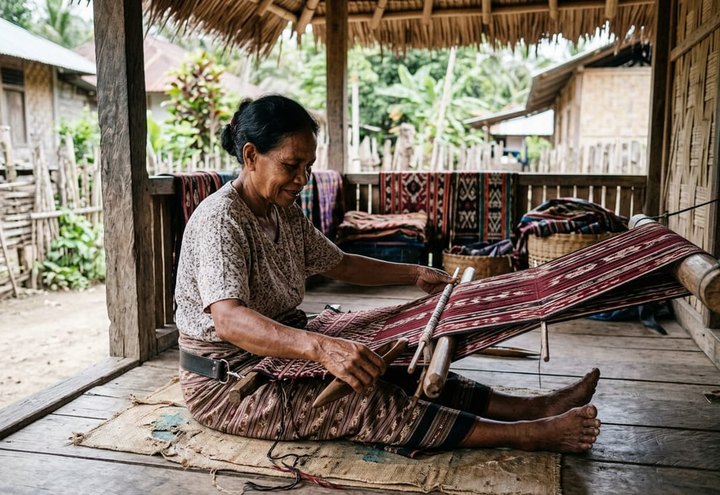
- Tais, Timor-Leste. Backstrap-woven cotton in regional patterns, made for weddings, funerals and formal welcome rather than for display. Buy in the districts where it is woven.
- Ikat silk, Uzbekistan. The Fergana Valley workshops still bind and dye warps by hand before weaving the rippling patterns known locally as abr, cloud. Silk and silk-cotton bolts travel flat and well.
- Silk weaving, Laos and Cambodia. Highland Laos holds some of the finest natural-dye supplementary weft work in Asia; Cambodian weavers work the tie-dye technique known as hol, a tradition rebuilt after decades of interruption.
- Lacquer, Vietnam. Many thin layers of resin, each cured and polished, over wood - sometimes inlaid with crushed eggshell or mother-of-pearl. The depth is the point, and it does not photograph.
- Ceramics, Japan and Korea. Kiln towns in both countries still fire in local clay bodies and glazes with long lineages. Pieces are chosen to be used daily, not shelved.
How to buy well
Ask what the piece is for before asking what it costs; the answer separates a working tradition from a souvenir. Look at the reverse of any textile, where handwork declares itself. Expect to pay more at the source than at an airport and to get something different for it. Carry cash in the local currency, ask about export rules for anything antique, and buy one good object rather than four adequate ones.
Timing helps as much as budget. Weaving and firing follow seasons and festivals, and a workshop visit arranged a week ahead is usually possible where a same-day one is not. Pack for the return leg as well: textiles travel flat and forgive almost anything, lacquer and ceramics need a hard-sided case and a day spent finding decent packing material at the source.